Double crossing bandits

Thursday’s Game
My game yesterday was fun. My friend had previously tried to double cross a travelling Neotechnoist merchant and his guard, which resulted in a close call with death-by-hanging thanks to a town sheriff. After some bandits broke in and won the fight against the townsfolk, my friend decided to join up with them. He took his share of the loot and equipment, and then headed south to go to a “Thickskull” nest to get himself a Dinomount.

After getting attacked by an adult Ripper him and another new bandit member were sent to explore the Ripper nest. The entrance caved in during an attack, and him and the bandit groupie continued deeper in the cave. Eventually he swam down an underwater tunnel that surfaced in a vine covered chamber. In a home built amongst the vines was an old man who had been there for 5 years. Some chatter back and forth and eventually it’s shown that the man killed his colleagues and tried to make a staircase from their bones to escape through a hole in the top of a chamber nearby. They fought and my friend killed the double barreled shotgun wielding old man by using grenades.

When he escaped out of the cave he decided to double cross the bandits. I don’t get what his deal is with double crossing everyone, but it makes for a dull game because he can’t do any “canned” missions like “Go here for X dollars, do this for Y dollars”. Instead he’s pretty much on the run all the time for being a jerk to people, and now he had screwed both the law abiding citizens of New Mexico, as well as the menacing bandit element.

He tried to make a run to Albuquerque to catch a 400 mile Flapper ride to Utah, but was caught outside the city by 3 newbie bandits, 2 full bandits, a bandit sergeant, and their Horned Dinomount. After dispatching the newbies he played cat and mouse for a bit, but eventually the combined firepower of the others brought him down and killed him.

His next character idea is someone who starts in Washington, and gathers enough supplies to make it to Canada (British Columbia specifically). Out of all of the USA he has to choose to go north to Canada, ugh.

Rules Thoughts
Anyways the system held up well again, and the Traits added a lot to it. I’m still having some trouble balancing AR vs Attacks, but I think that’s because he never really stopped running long enough to buy better armor with all his money. Having a total AR of 3 basically means you take a lot of damage…a lot a lot. But then again if he had gotten a Dinomount instead of trying to shoot everyone 10 seconds after meeting them, his AR wouldn’t be so awful. Apologies if I sound frustrated, haha.

In terms of the rules I’ve polished and refined them a bit more, and will continue to do so as I do more play testing and real games. Getting pretty close to done now, besides the zillions of enemies I want to make. I also might update the History a bit to include a note about Canada, and maybe how Alaska is considered an untouched paradise or something (sort of like Shell Beach in Dark City or the island lands in Mad Max or flat out land in Waterworld [yeah, I just referenced that movie in a serious context, so what?!]).

Update
I’ve completed the section about Canada and Alaska by adding a simple paragraph to the History section (under the “Eruption Day” header), duplicated below:

To the north Canada was covered in ash and eventually emptied as unprepared citizens escaped the cold by fleeing south. The country remains forsaken and abandoned, covered in blowing snow and choking ash and ruled by dangerous creatures. Rumors persist that Alaska endures untouched by the eruption's devastation; a veritable paradise for those brave enough to explore northwards.

Dinomount gallery

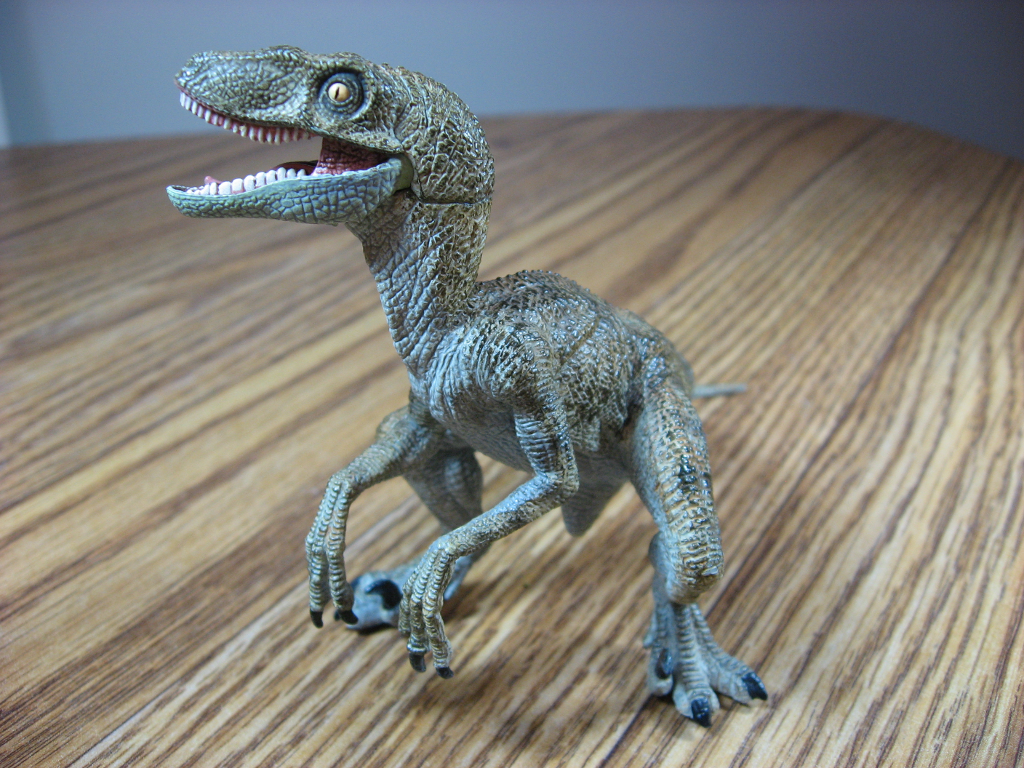
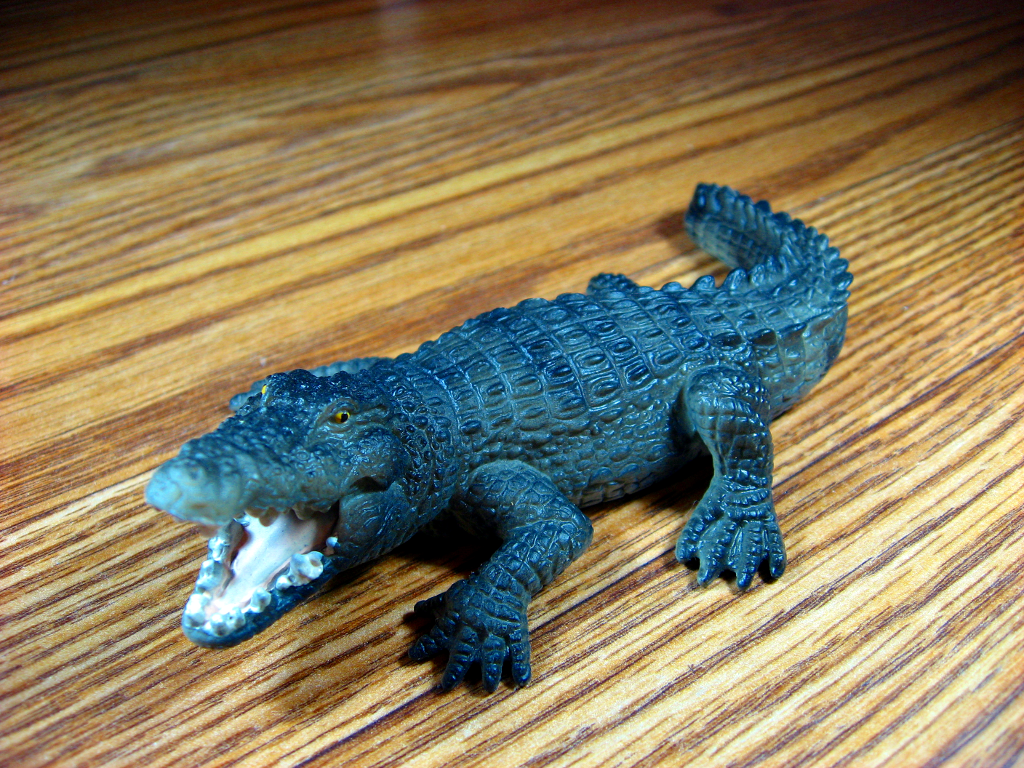
Annnnnd I’m back. That ended up being quite a gap, but holidays and busyness tend to do that. Anyways…2010 is here! We don’t have battery powered laser blastin’ six-shooters, but hey, at least 2010 sounds futuristic. Anyways I got a chance to photograph my collection of Dinomounts so far. There have a tag from the company “Papo” on them (except the Crocodile and Runner). Definitely highly detailed and good quality, and I wish the range had a few more types available. It’s kind of nice to get durable plastic toys instead of fragile metal figures, and so far they’ve added a lot to the game (especially in the big bandit raid last game, before the holidays).

I had a great idea for Traits as well, which I’ll talk about below after the gallery (note you should mouse over each for the type of Dinomount shown, and click for a larger [1024×768] picture):

Dinomount Gallery
Ducky Horned
Plated Raptor
Runner Thickskull
Crocodile

Traits Idea
Right, so the Trait breakthrough. First of all, Damage Tracks have been kiboshed. Dinomounts just provide a flat HP bonus to their riders. This really simplifies things, and stops my from feeling like I simply ripped off Silent Death (without actually improving one of their best mechanisms).
To make up for this simplification, and perhaps partially inspired by the Action Skills in the computer game Borderlands, I’ve decided to split Traits into Active and Passive. Passive just provide simple stat bonuses like +X Movement, +X Attacks, and so on. Or they provide generic other bonuses like a bigger inventory or faster overland travel or things of that nature.
The real fun are the Active Traits. Basically each Active Trait has an effect and an Activation Number (still working on the term…). Whenever a To-Hit roll is greater than or equal to the Activation Number, the effect of the Active Trait is applied to the enemy. You can switch your current Active Trait (or not even use one) any time before making an attack in combat.
I’m also considering some sort of re-skill fee that lets you pay Neodollars to erase your current Active Traits and choose new ones. I’m thinking (Level * $20) or something, to make it easier to try different Traits at lower levels, compared to higher levels when you should have a pretty good idea of what works.
So, as an example, let’s say an Active Trait is called “Crippling Shot”, and has an Activation Number of 9. If I’m firing with a standard 100KW Six-Shooter (4 Attacks), any roll of 9+ applies the Crippled effect to the target, which reduces their Movement by -1. Simple and fun and lots of options for hindering your enemy beyond just flat out applying damage.

Problems with this new idea? Well, obviously guns with more Attacks would be “overpowered” compared to those with low Attacks but high Damage. I’m thinking that the Activation Number will be a sort of “base” number, and can be modified and calculated depending on the weapon. For example if you have 1-2 attacks, lower the Activation Number by 1, so it makes up for having less chances to Activate by being easier to activate. I’m still trying to find an elegant solution to this.

So anyways, I’ve got a bit of work with redoing character sheets and enemy sheets (too bad I’ve already printed a ton of them!). I think I’ll just update the Dinotypes table in the Rules to have the +HP bonus right inline, which negates the need for Dinocards (which I mentioned before). I’m going to keep Break Tests (probably just at certain HP thresholds, like 50% and 25%, or maybe under certain effects like if they take 10+ damage in a single turn), but otherwise I can pretty much wipe out the entire Damage Track section. Once all that is done I’ll just have a bunch of enemies to make up, but that’s an ongoing process anyways, so yeah, should be getting close by the end of January!

First “real” game

Thoughts from Yesterday
Well my first “real” game (ie: not just playtesting alone) went well yesterday. I was the GM and my friend played a Duster who started in New Mexico. He shot up most of the people he met which resulted in him being knocked out and captured by bandits, and then after escaping getting captured AGAIN and almost hung by angry townsfolk and Neotechnoists. Good times.

The game held up very well. It would have been nice to have some Traits done, but even without the added variety and options of those there was plenty to do in combat. I also would have liked some printed enemy sheets, since I sometimes had to fill them in as I went.

I had a bit of a “woa, wait a second” moment when I considered the possibility that Dinomounts don’t actually add anything to the game. Heresy, I know. Well, maybe what I should say is the Damage Tracks on Dinomounts don’t add much to the game. Maybe it would be better to just have Dinomounts add a flat +HP bonus. That sort of makes them just like pieces of equipment you wear to boost stats, instead of a separate entity.
But I worry that the whole reason I put Damage Tracks in was because I loved it so much in Silent Death, which they are based off. The whole degrading movement and armor as you go SEEMS like a fun idea…but is it really in practice?
So if I took out Damage Tracks and did make Dinomounts glorified +MV, +AR, +HP pieces of equipment, where would that leave the feel of the game? Well…almost too simple. Maybe I’d have to add in crouch and prone to make up for it, or something extra to give the player more choice than “move and shoot”.
I guess once I get a few Dinocards done up and integrate them into the game I can see how it plays. I guess I just find the foot combat so much fun already that I don’t know if extra steps and tracking will add much to the game.

Also I might want to change how AR works. Right now people get shot, a lot. With 2 AR as the base and 3 pretty much standard for the first two levels, you’re left taking a lot of hits. But I had to keep AR relatively low in preparation for a person getting a Dinomount (which normally boosts AR). What I might do to solve this problem is make base, unmounted AR higher (ie: 3 default, 4 or 5 common for low levels, which is 6 if you’re in cover which is a nice chance to dodge) and then put a cap on the bonus from Dinomounts. Like they would have “+2 AR max 6” or something, so if you don’t have much armor you still get some bonus from the Dinomount, otherwise not really. Anyways, think of that possible mechanic similar to the max Dex bonus in D&D, or something along those lines.
That is a further reason to just remove Damage Tracks, since why would you care about losing AR from your Dinomount when you’re already at their max cap?
Another possibility with this is to make base AR higher, but start having movement penalties right away, so you can be either heavily armored and slow, or lightly armored and fast. Hmm, that might restrict characters too much though.
Who knew I’d actually have problems with armor though?! Normally that’s an easy thing to solve, but I guess I just set the base too low to begin with.

Anyways…

Radio Silence
Well Christmas is approaching, and I’m taking next week off work, so don’t expect many posts from me. I hope to get Traits done and start filling in some enemy sheets, but yeah I’ll likely get too busy with family obligations to write much here. So if there isn’t a post until the new year, you’ll know why!

Matching weapons and level…and rambling

Levels and Guns
My playtesting character is now at level 3. I’ve been running a mini campaign with him where he darts around North and South Dakota, and just from a few fights here and there he’s reached 20 Kills.

The problem with this? He is still using his original 100KW Six-Shooter, his AR is 4, and he only has ~$120.

Part of the blame is on me, as I tend to not give out enough loot. But I also think that the amount to level up might be a biiiiiiit too little. I think there is a definite possibility that you level two or three times during a single job, and yet don’t have time (or money) to stop and upgrade your equipment. I guess there aren’t a ton of benefits to each level, especially since the Traits aren’t done yet, but yeah, the bonus HPs do let you take on more of the same opponents, so that’s fun.

I guess it’s just a difficult balance, and not one I had really expected. I think I can clarify some of the rules to help prevent this, but a lot of it will fall to each individual GM.

Although, a 100KW Six-Shooter isn’t exactly trash. I guess in D&D equipment didn’t fly up and up and up at a comparable rate to level gain, but then again you had magical loot you could buy too.

Skill Checks
Anyways I changed how Skills work, after some more play testing. Originally your Skill was a value you had to <= to succeed on a check. Okay idea in theory, less than okay idea in practice (considering you start at 2 Skill…and are rolling a D12). So instead I changed Skill to be a bonus like Courage, and you need to roll above a set Challenge Rating (CR). The default is 6, but tougher more complex tasks can be higher. I think this is better and gives a bit of difference in skill checks, instead of it totally being based on your current level.

Break Tests
In addition I changed the Fleeing result for Break Tests. Thanks playtesting! I realized the “edge of the board” is pretty freaking close most of the time, so if you get that result you are pretty much out of combat. Instead I changed it so you run for one turn, but recover after. Almost like Stunned, except that you move away from the enemy. I might just bite the bullet and combine the two in the future, but we’ll see.

Running…Overpowered?
Unbelievable, but maybe true. The ability for a Dinomount moving 7″ to hop across the board at 14″ is pretty powerful, especially for monsters that normally move faster than the players and tend to be nasty in close combat. But I don’t know what else I can do for running…I could take the 40k approach and say Move+D6″, but I never liked the random aspect (I think it removes tactical strategy as you can never totally depend on where a troop will be and when). Maybe a second score, a Run score, that would be something like 6″ if you have 4″. This might be fun, since then I could make creatures that are really fast at running, but slow to walk. Hmm I just thought of this idea, and already I kind of like it. Sure it’d be one more stat, and I sort of have 20+ mini-sheets printed already with only a single MV value…but yeah…we’ll see.
Maybe I just need to play on bigger boards.

Ready for Tomorrow
I printed off the remaining rules today and put them into a binder. Plus I put a bunch of enemy mini-sheets in a second binder, and can slowly fill those out and order them and so on. I wonder if there is a way with a spreadsheet to create a “template” and just fill in values, that way I don’t have to go through 300+ enemies if I want to change the formatting or something. Hmm maybe I should make the mini-sheet out of HTML or something instead.
Anyways, back on track. I have a few state level maps to play across, and a bunch of neat ideas rambling around for simple jobs and tasks. I’m excited to try the game with someone else, as normally a second set of eyes immediately notices blatant errors or mistakes I’ve been ignoring since I look at the rules every day.

So anyways, sort of a rambling post, but there are some thoughts as I come closer to finalizing a v1.0 of the rules.

A slew of posted documents

Well I figure it’s time for an update. As usual the weekend filled up with non-Dinosaur Cowboy related activities, but I still got the Sidekick sheet done before, and then did some rule formatting earlier today. My TODO list is looking pleasingly small now, with the big leftover sections summed up as “Traits, Dinocards, Enemies”. Here’s the actual document I’m tracking from:

Rules.odt
- Finish Traits
- Finish Dinomount section

General
- Make Enemy cards
- Make Dinocards
- Make example jobs / campaign?

I am having a playtest with someone else on Thursday, and am going to try to get a short game in before then (maybe tonight or tomorrow). Dinocards and the Dinomount section in the rules are my next priority, as well as some basic Enemies. I’ve still been stewing over Traits, and that list will probably be the last thing I put in.

And now for the latest version of all the documents I’ve been working on, again in ODT or PDF format:

Rules: ODT | PDF

Items (Weapons, Armor, Equipment): ODT | PDF

Character Sheet: ODT | PDF

Sidekick / Enemy Sheet: ODT | PDF

I’ve had less to brainstorm and think about as less sections remain overall, so that’s why the post frequency has slowed down. Now I mostly am nose-to-the-grindstone working away at the rules and hammering out the actual implementation instead of just thinking about the mechanics.

Hooray so exciting seeing the project come together!

Section excerpt – Game Overview

I tend to have a tough time writing the whole summary of what exactly a tabletop skirmish RPG is…I guess because I just grew up playing games so the idea of starting from scratch is tough for me to visualize. I think the big names (D&D and 40k) are great for walking players through this whole process, but yeah, I took a stab at it below for my “Game Overview” section in the Rules, which is now complete:

The way you setup and play Dinosaur Cowboys will be familiar to anyone who has played other tabletop skirmish or roleplaying games.

Each player takes on the role of a character (such as a sly gunslinger, a rich noble explorer, a old weary sheriff, etc.) and immerses themselves in the futuristic world outline above. Players can pit small gangs or posses against each other in a one time battle, or link their fights into an ongoing campaign woven with narrative, travel, exploration, purchases, and more.
Although not strictly necessary, a Game Master (GM) is strongly recommended for campaigns. The GM's role is rule arbitration, map setup, control of foes, moving the storyline along, and shaping the world to react to the player's actions.

Dinosaur Cowboys is played using 28mm figures to represent characters and dinosaurs, but other scales work just as well. Combat is represented using the rules below, and is managed by moving the figures across terrain. The actual pieces of terrain can range from high quality styrofoam plots of land and craftily shaped trees to a simple cloth mat spread over stacks of books to make bumpy hills.

As a character advances through the world they will grow in ability and be able to surmount new, exciting challenges. The first task a GM presents to a fresh character may be as simple as stealing dinosaur eggs. Then months later (either in game time or real world time) the character can be founding (or conquering) towns, forging new frontiers and shaping the fate of the entire country.

Also I added rules for Sidekicks. Originally I was going to call them Followers, but when looking for descriptive words to elaborate on what exactly they were, I stumbled across “Sidekicks”. It seems more in the tone of Dinosaur Cowboys, so I’m going to keep it.
Anyways, basically they are henchmen / NPCs that travel with a character (and are controlled by them in combat). The upside is they don’t use the full character sheet, they use the mini-sheet that is similar to the enemy sheet. So you can fit all your Sidekicks on a single sheet, which certainly beats shuffling through a stack of them. Right now I’m saying max 2 Sidekicks at Level 1-7, then 3 Sidekicks at Level 8+. Also I recommended party size (in total, amongst all players) not exceed 5 or 6. I’ll have to actually do some larger tests to see at what point exactly the game slows down / bogs down from too many combatants.

Anyways next up is the mini-sheet, which will also be the basis for Dinocards.

Then after that it’s pretty much Traits left. So far I’m vaguely been brainstorming names of Traits…the biggest issue will clearly be balancing them all against each other. But yeah, then I’ll put some enemies together, think up some quest ideas, and kapow! ready to play.

I’m likely going to do some external testing (ie: with another person besides myself) next week, so that should be a good trial. Hopefully I have enough unchanging rules done to get a campaign going.

How the year 2285 REALLY looks

I finalized the Overland Map so it isn’t a crude Google Maps ripoff. Here is a tiny preview, but I suggest clicking on it to open the IN YOUR FACE size (1535×1335 pixels):

Finalized Overland Map

I am especially pleased by the new sealine on the east and west coast…it almost looks natural. I decided to cut out Canada and Mexico completely to leave the focus solely on the USA. I should think up a new name instead of “USA” though, since I doubt it’d be called the same in 2285. How about…Dinoland! Yeah…I’ll work on it.

Anyways the tree images making up the volcanic jungle are GIMP Brushes from this dA account (basically the first Google search result for “GIMP tree brushes”). I’ve never installed or used custom brushes before but they did a great job and look pretty nice. The basic map is from the official USA Atlas site (although I forget the link now, and had to painstakingly convert it from PDF to a huge sized image to work from).

I might apply a few fancy pants filters to make the map look all worn and old, but for the version that’ll be embedded in the rules I’ll keep it pretty simple and clean.

Anyways, the rest of my progress is going pretty well. I’m slowly filling out the rule sections, and just did the Damage Track explanation and diagram and stuff. I’ll probably do a few more bits and then post an updated copy. The character sheet remains pretty much untouched (besides changing Dinomount Size to Type). My next highest priority task is making the “mini-sheet” that will be used for Followers / Henchmen and enemies. I’m hoping 3 will fit on a single print out, so then I can really pack a bunch of information on allies or foes together.

Oh and the rule for Dinomounts “dying” (ie: reaching the end of their Damage Track) has always been that they were Downed. Well now I came up with the item that will restore them after a battle (think Phoenix Down from Final Fantasy). It’s called Sal Volatile and is basically fancy smelling salts. It’s also nicknamed “Jolt Juice”, “Sparker”, or “Alarm Clock”. Sort of a nice simple idea that keeps the tone light.

Anyways, I have tonight and tomorrow night free to work on rules, and then I’m busy until Sunday night. Hopefully I can get the Game Overview and Followers section done in the rules, and then the mini-sheet as well.

“You may fire when ready…”

Well that was a productive weekend. I chipped away at a slew of sections in the emerging rulebook, and more importantly created the weapon and armor lists, which I’ll post in a sec. I still want to do some testing for balance (especially comparing some weapons, since I tried to make the stats balanced, but sometimes glaring flaws expose themselves once the dice start rolling). To that end I might write a simple script or program where I can input a weapon’s stat line and have it autoroll a bunch of combat simulations (different ranges, different target Armor Ratings, etc.) and then spew out a bunch of statistics.

I also added a series of “Quickstart Packages” used during character creation, since I find that new players have no idea what is considered a “good gun” until they’ve played through a few times. This way they can just grab “The Shooter” package, or “The Berserker” if close combat is more their thing, etc.

Anyways, here is the Weapons/Armor list as an ODT or PDF download:

And to complement those lists I figured I should post the related “What column means what” section from the rulebook as well as the common Special abilities (like Explosion, Hail of Bullets, etc.). Plus I filled in a general description for each weapon (like D&D did it) so that people know what exactly a Blastbow or Glowlash is (although most of them can probably figure out a Pump Shotgun…except it’s fun to know it fires a spread of plasma – hey don’t quote me on the science side haha). I did try to keep the armor materials relatively realistic without straying too far from a wild west feel (which is why most of them are called Shirts, like Biosteel Shirt, to avoid the whole power armored cowboys aspect).

I like how the Grenade type of weapon turned out. I still avoided individually tracking grenades by having them “Auto” reload, meaning after you throw one you have to spend another Action Phase prepping another grenade. And I made sure to have plenty of silly types of grenades, right down to the Defoliant Grenade (something they had in Warhammer 40k 2nd edition, but removed later because I guess it wasn’t “scary dark future, okay!!!” enough for them).

And please ignore any messy formatting or wall of text action going on below, as Open Office doesn’t exactly output the cleanest HTML, and I run out of energy to reformat it all myself.

Weapons and Equipment

Neodollars: The modern currency is called a "Neodollar", and uses the "$" sign or, rarely, "ND". Each bill is durable paper about 8" long and 3" wide, and marked with a variety of vistas from the Neotechnoist jungle. Although printing is controlled by the Neotechnoists, money still escapes into the poorer, surrounding wastelands.

Maximum Burden: Because of the proliferation of Dinomounts, tracking of item weight is not done. Instead the only limitations are based on size.
A character may carry a maximum of 2 Large weapons and 1 suit of Armor. Note that one Large weapon translates into 2 Medium weapons, or 4 Small weapons.

Improved Weapons: As a character explores they may come across improved version of the standard weapons they are accustom to. These improvements are marked in the name of the weapon as follows:
Weapon +XA: X may be any number from 1 to 5, and specifies how many bonus Attacks the weapon grants.
Weapon +XD: X may be any number from 1 to 5, and specifies how much bonus Damage the weapon does.

Special Abilities

There is a preset list of common Special abilities that are assigned to various weapons. The description for each follow, although more may be created at the GM's discretion:

Both Barrels: Mark a loaded weapon as requiring a Reload and add +2 Attacks for one Action Phase.
Hail of Bullets: Reroll a single Attack dice, keeping the second result.
Scoped: Ignore the +1 Armor Rating bonus provided to targets in cover.
Seeking: No attack roll (Step 1 in the Combat section above) is made, instead the target is automatically hit.
Fireline: Draw a straight line from the firer in the direction they wish to attack, up to the maximum range of the weapon. Any entity (friend or foe) the line passes over suffers an attack from this weapon.
Explosion: Resolve a normal attack against the target. If hit, any entity (friend or foe) within 2" take the base damage of the weapon.
Big Explosion: Same as Explosion, but with a 4" radius.
Knockback: On hit the target is moved directly backwards from the firer for 1D6 inches.
Blind: On hit the target is blinded and has -1 Attack (minimum 1) during their next Action Phase.
Stun: On hit the target is stunned and cannot make any attacks in their next Action Phase.
Web: On hit the target is paralyzed in place and cannot move in their next Movement Phase.
Cover Breaker: On hit remove 1 piece of vegetation based terrain (such as a tree). What constitutes a single piece is at the GM's discrection. Note trees use the default Armor Rating of 2.

Weapon Table Information

Over sixty weapons are outlined in the Items.odt file. This list can be considered a template, as even a simple weapon like a Pump Shotgun can vary between areas in the country.
The statistic columns of the chart are outlined below, as well as detailed descriptive text for each weapon:

Name: The common name or designation of the weapon.
Cost: The cost (in Neodollars) of the weapon. This price may vary between locations.
Short: The short range of the weapon. See the Combat section above for details on what Short range does.
Med: The medium range of the weapon.
Long: The long range of the weapon. See the Combat section above for details on what Long range does.
Attack: The number of Attacks the weapon uses.
Damage: The base damage of the weapon. This value may be 0.
Reload: The reload, jam, or overheat chance of a weapon.
If the value is None the weapon never needs to be Reloaded.
If the value is Auto the weapon must be Reloaded after each use (an example would be grenades or a single shot rifle).
Size: The size of the weapon, either Small, Medium, or Large.
Req: The level requirement to use the weapon. A character can still carry (in their inventory) weapons they don't meet the level requirements of.
Type: The category of weapon, either Energy, Projectile, Grenade, or Melee.
Energy weapons are most likely laser based, especially if the Name has a Kilowatt (KW) or Megawatt (MW) rating in it. Otherwise it could also fire plasma or energized particles.
Projectile weapons are likely gunpowder based and old fashioned, similar to the weapons of the 21st century. Typically these relics cost more than a comparable Energy weapon.
Grenade type weapons are manually thrown at an enemy, and will always have a Reload value of Auto. This represents grabbing another grenade from a bag or bandolier. Individual grenades are not counted or tracked, so think of each Grenade weapon as a collection or pack of weapons.
Melee weapons are used in close combat only, see the Combat section above for details.
Special: Any complex effects of the weapon. See the details above for each ability.

Weapon Descriptions

Six-Shooter : By far the most common ranged weapon the ubiquitous six shot revolver has, on the surface, remained unchanged since the old wild west. However now in the place of solid lead bullets, incredibly high density batteries are used as ammunition. Each contain enough energy to generate a single laser blast of Kilowatt power, a level of drain that only battleship size cannons could propel earlier in the 21st century. These high tech revolvers are a daily reminder of the advancements in technology.
Pistol : Although these handguns have greater range and accuracy, they remain less used than the classic revolver as they tend to break down in dusty conditions, and don't fit in with the idealistic cowboy image most of the population strive for.
Handcannon : Drawing from a linked set of battery ammo allows these large bore handguns to fire wide, thick laser beams.
Bow : By drawing and enhancing the frictional energy created by pulling and releasing a bow string, these weapons allow the firer to propel laser beams without having to worry about reloading.
Pump Shotgun : These common weapons have been updated to fire clusters of burning plasma at a target. The pumping motion of one model of shotgun regenerates the plasma cells in preparation for another shot. A second common model has two independently charged barrels, much like the double barreled shotguns of old. And finally the automatic shotgun, which is powerful but tends to overheat quickly.
Lever-Action Rifle : Like the classic six-shooter, the lever-action rifle has been updated to 2285 standards. Each pull of the lever will reload another high charge battery in preparation for another shot. The larger batteries and longer barrel allow greater range and impact that revolvers, and can even achieve Megawatt levels.
Twin Rifle : Similar to the lever-action rifle, this laser rifle has two vertically stacked barrels to increase firepower. Normally these come in a 200KW energy range.
Burst Rifle : By using smaller, lighter batteries the burst rifle trades penetrating power for a higher number of shots. Preferred by gunslingers who have poor accuracy, as the sheer count of laser beams being fired in a wild spray from this weapon is likely to hit something.
Rotary Rifle : Updating the gatling gun design from the old wild west, this modern rotary rifle can achieve the highest rate of fire of any weapon.
Scoped Rifle : Used by snipers and hunters, scoped rifles fire single condensed laser beams, relying on damage over a hail of shots.
Throwing Knife and Axe: These crude weapons are normally chosen for style over functionality, as even the most basic six-shooter outperforms these bladed weapons.
Stub Pistol : Commonly designed like the projectile slinging guns of the 21st century, the expensive and carefully crafted solid bullets can inflict far greater wounds than a laser beam from a comparable revolver.
Crossbow : Firing jagged and barbed bolts, this simple but effective weapon is capable of catching an unwary enemy off guard.
Sawed Off Shotgun : With a shortened barrel this shotgun is used to spray a dense cloud of metal shrapnel or pellets at a target.
Bolt  Action Rifle : This single shot rifle is sometimes preferred by rich hunters and scouting parties of nobles for the loud report and bright muzzle flash. Unfortunately modern technology has outdistanced the large caliber bullets, and most scoped laser rifles do far better damage than this relic.
Assault Rifle : Complete with wooden stocks and curved magazines, these fearsome weapons are great for spooking dinosaurs and raiders alike.
Needler Rifle : A specialized rifle loaded with advanced self guiding bullets, this weapon is normally reserved for targets with otherwise impenetrable armor.
Bazooka : Comprised of a crude metal tube and heavy self propelled rockets, the bazooka is a crowd pleaser.
Rocket Launcher : The addition of a magazine of smaller rockets allows this weapon to fire a few times before needing to be reloaded, while still maintaining a relatively destructive blast.
Grenade Launcher : An elegant weapon to rapidly fire a stream of microgrenades at a target, with the benefit of showering the nearby area with razor sharp shrapnel.
Flamethrower : Uncommon and devastating, the flamethrower spews burning chemicals in a small arc around the user. Terrific at catching dinosaurs off guard, clearing bunkers, or starting a campfire for dinner.
Boom Grenade : The most common grenade, this weapon comes in a variety of shapes and sizes. Most are simple cylinders thrown by hand, but some may be tins of explosives stuck atop wooden sticks.
Kaboom Grenade : Similar to a boom grenade...just bigger.
Riot Grenade : These rubber tubes of stinging, compressed air blow opponents backwards upon explosion, and were used in some of the early food riots in Haven.
Dazzler Grenade : With a deafening sound these grenades exploded into light, temporarily blinding human or dinosaur eyes.
Stun Grenade : These grenades explode by thundering a low frequency pulse outwards, which momentarily stuns and incapacitates nerve endings.
Tangle Grenade : Commonly used to trap charging dinosaurs, these grenades shower a target with a chemical mix of fast bonding glue.
Defoliant Grenade : An improved herbicide spray that can be used to clear a swathe of thick vegetation. These were used during the early exploration of the volcano jungle.
Shank , Knife, Machete: Crude stabbing weapons used to slash at targets and sever limbs.
Sword s: Ranging from the length of a hand to the size of a man, swords have been common since the early centuries of mankind. Aside from improving the materials used in construction, little has changed in the design since then.
Motor Blade : Powered by a small battery cell, this thick steel blade is covered in numerous spinning micro-drillbits which carve human and dinosaur flesh with equal ease.
Axe : Savage and barbaric, the axe is a harsh reminder of a darker time in humanity's history.
Staff: An elegant wooden or steel rod, the staff can be deadly in skilled hands.
Spiked Flail : This weapon inflicts painful wounds through a heavy, spiked ball that is chained to a handle by incredibly durable, microscopic wire.
Hammer : Ranging from small one handed claw hammers to large headed sledgehammers, these weapons can cause enemies to flee in terror.
Club : Simple and effective, this weapon can be anything from a sturdy wooden plank to a reinforced crowbar.
Spear : Arguably one of mankind's first weapons, the spear is perfect for harassing dinosaurs at a safe distance.
Glowlash : A modern version of the whip, this sparkling length of controlled particles can rapidly be sliced across the surface of a target.
Electrolance : This weapon is a long steel lance tipped with a powerful electrical discharge unit.
Scorchlance : This weapon is a long steel lance that is sheathed in superheated energy.
Twinlance : Although heavy and slightly unwieldy, this double pronged lance can be devastating in the right hands.
Shudderlance : Vibrating several hundred times a second, the well known shudder lance can use stored kinetic energy to blast a target backwards.

Armor Table Information

A variety of armors are available for use from the Items.odt file. These range from a common cloth shirt to more advanced defensive sheaths necessary to withstand the fearsome blows of a dinosaur. Note that only the most common armors are listed, and other materials and types of armor may exist.
The statistic columns of the chart are outlined below, as well as detailed descriptive text for each suit of armor:

Name: The common name or designation of the armor.
Cost: The cost (in Neodollars) of the armor. This price may vary between locations.
Armor Rating: The equivalent Armor Rating of each piece of armor, up to a maximum of 6. Without armor a character will have an Armor Rating of 2, which is the default and minimum.

Armor Descriptions

Clay Plates : This armor is created by reinforcing superheated clay with soft layers of inner padding.
Woodward : Crafted from hardy jungle trees, this suit of armor involves strapping carved and fitted pieces of wood to key locations, normally under other clothes.
Bonestack: Made up of a variety of dense bones, this armor is crude by effective at reducing the pain of a dinosaur bite.
Dinohide : Painstakingly formed from a variety of tanned dinosaur pelts, this suit is extremely common for its ease of customization.
Mesh Shirt : Formed from links of durable metal or thick rubber, the mesh shirt is preferred by anyone with a flair for style, as it can seamlessly be worn under clothes.
Flak Covering : A bulky vest useful in protecting the wearer from shrapnel and teeth.
Metal Plates : Heavy and cumbersome, a solid sheet of metal protecting vital areas is great for peace of mind.
Ceramic Plates : Formed using modern mixing techniques, ceramic plating is useful for deflecting or absorbing weapon shots.
Kevlar Vest : Uncommon and outdated, 21st century kevlar is still sometimes found in law enforcement groups.
Vectran Vest : An updated version of kevlar for 2285, the vectran vest can stop most shots with only minor discomfort to the wearer.
Thermoplastic : Worn outside clothes like a type of carapace, thermoplastic armor is useful against most energy weapons and blunt trauma.
Biosteel Shirt : Woven from thin, lightweight fibers harvested from giant jungle spiders, biosteel is a perfect choice for maintaining mobility.
Kinetic Shirt : Based on a recent breakthrough in the realm of personal protection, a kinetic shirt basically reverses the energy of an incoming attack to deflect the blow.
STF Covering : Developed near the end of the 21st century, shear thickening fluid (STF) was assumed lost after Eruption Day. However a group of explorers uncovered the secrets to its production several years ago. The magnificent liquid instantly hardens a nanosecond before an attack penetrates to flesh, providing maximum protection without sacrificing weight.
Ferrobone Vest : Using rare ultradense bones reinforced with steel and biosteel, a vest of ferrobone can make the wearer nearly impervious to pain.

And thanks to the musical joy of Husky Rescue (especially their 2004 CD) and Shawn Lee’s Ping Pong Orchestra for keeping my mind focused while filling in rows and rows of stats.
My TODO List

Around this point in development (ie: half done the main Rules doc) I tend to prefer to get a big, long TODO list going. It’s motivating to mark stuff off it, and it helps to stop me from forgetting key stuff (like, um, “design some enemies!”). And although the following list might look (relatively) small, some of those points are megaaaaaawork:

Rules.odt
- Edit History
- Finish Game Overview
- Run through Character Creation with a few varieties
- Test max Level character
- Update Step 7 (Dinomount) in Character Creation
- Finish Example Completed (Character) Sheet
- Finish Traits
- Finish Weapons and Equipment section
- Finish Dinomount section
- Redo and clean up Overland Map, make it full page (landscape)
- Finish Towns and Cities subsection
- Finish (or remove) Miscellaneous section

General
- Make Enemy cards
- Make Dinocards
- Make follower rules / sheet
- Make weapon list
- Make armor list
- Make equipment list (including drugs?)
- Make Google Maps copy of Haven and jungle in Wyoming
- Make example job / campaign?

Combat rules! (and Rules)

Oh ho ho see what I did in the title? I’m so witty it hurts.

Righto, so I copied over and fleshed out the mumbo jumbo in the brainstorm notes to the rulebook for the combat section, and now I’ll paste it all here. The example Ranged and Melee combats are rather uninspiring, but once I get a few more rules done I hope to do a mini “battle report” (similar to something you’d see in White Dwarf) complete with diagrams and all that good stuff. Probably a little more detailed, since I think showing dice rolls and mechanics would help give a super clear understanding of combat.
Although I don’t think the pictures will be very inspiring since I don’t have any dino riding cowboy figures made yet.

But yeah, I am really happy with this system so far. It’s quick to play without just being a ripoff of the D20 system. I managed to avoid the tedious adding and subtracting of a slew of modifiers that games like Battletech run into. Sure I love the idea of representing crouching, running, size differences, ranges, fog, prevailing winds, humidity, and everything else (okay, maybe not quite that ridiculous) but the whole “Okay, +1 for X, +1 for Y, +2 for Z, -1 for A…” can get boring.
Instead I have a few modifiers, and make the most of them. Short Range = +1 Attack, Long Range = -1 Attack. In cover? +1 AR. Melee Charge Bonus? +1 Attack +1 Damage. Done.

As for the combat system itself, it vaguely reminds me of Advanced Heroquest with it’s Damage Dice (but maybe that’s because I’m using some D12s from the original box set, haha). And of course Silent Death for the Damage Track, but I thought that was the best way to have mounts degrade in combat ability as they take damage. Plus it means I can have “durable” DT (like those that only lose their Movement near the end hits), or “frail” DT that start to fall apart after 5 damage.

The other aspect I really like is being able to use the same system for ranged AND melee combat. Splitting that was REALLY painful in the last ruleset I did, and just meant you were basically having to balance two systems.
And I made firing into combat and running from combat no big deal, but I think that was influenced by spite against Warhammer 40k (5th edition) and their whole “Oh they touched your base, you’re locked in combat until THE END OF THE UNIVERSE”. Plus it means your fellow Cowboys can pour fire into a gigantic Cave Bear while you bravely hold it back with an Electrolance (cinematic sounding right, right?!)

As for ranged combat, I initially had considered having your “To-Hit” target value be based on your personal skill, and then your enemy’s Armor come in as damage reduction (this seems fairly common in modern games, ie: D20 Modern [I think?]). But that’s more modifications and more rolls and more stats, and I’m trying to keep this as a “light” RPG and “medium” skirmish game, so that approach had to go. Plus who doesn’t love “Roll X Attacks, are they >= target AR? Good, total them and add your damage, hooray”. The Critical Hit mechanism is simple and elegant too.

Anyways, first draft of the Combat rules:

Since the dawn of mankind there has been violence. The re-emergence of dinosaurs has done little to slow the carnage. In fact, if anything, it has accelerated the technology involved in weapons. Battles can be fought at a distance or in hand to hand.
This section will outline the rules for simulating fights between characters and wild dinosaurs or cunning bandits.

Determining Turn Order: Each combatant (or group of related combatants, such as a pack of "Rippers") rolls a D12.
The highest result moves their character first, then the second highest, and so on.
Whoever moved first is said to have won Surprise.

Step 1 – Roll Attacks

The number of Attacks a weapon has determines how likely it is to hit, and also adds to the damage done. Melee weapons for close combat can be augmented by the Melee Attacks of a Dinomount, as discussed in the Dinomount section below.

Roll a D12 for each Attack on the weapon you wish to fire.

Range Modifiers: If a ranged weapon is at Short range, add +1 Attack. If a ranged weapon is at Long range, subtract -1 Attack.

Step 2 – Determine Hits

Compare the result of every Attack roll to your target's Armor Rating.
Every roll greater than or equal to the Armor Rating (including any modifiers listed below) is counted as a successful hit.

Terrain Cover: Using a ranged weapon at a target in or behind cover (such as trees, hills, etc.) grants them a +1 Armor Rating bonus against that attack.

Critical Hits: Every Attack roll of 12 is considered a Critical Hit, and counts for 2 hits.

Impossible Armor Ratings: If the target has an Armor Rating higher than 12 it is impossible to achieve a Critical Hit, and only a roll of 12 will count as a hit.

Step 3 – Apply Total Damage

The total damage done to a target is a count of all hits plus the base Damage of the weapon (from it's statistics).
If the target does not have a Damage Track, subtract this damage directly from their Hitpoints, otherwise apply it to their Damage Track.

Ranged Combat Differences

Who Can Fire: If your character can see the enemy target and they are within Range of your weapons, you may fire at them in your Action Phase.

Reload Value: Each ranged weapon has a Reload value as part of their statistics, such as 2x1 or 3x1. This number represents how likely and often the weapon will need to be reloaded, but it can also represent jamming or overheating.
When rolling attacks in Step 1 above, if the number of dice that come up as 1s are equal to or greater than the Reload value, the weapon needs to be reloaded.

How to Reload: A character must spend an entire Action Phase doing nothing but Reloading a gun before it is usable again.
Note that only a single ranged weapon can be reloaded each Action Phase.
Also note that if a character has multiple weapons, they can just fire another gun instead of Reloading an empty one. If they choose to do this, it is recommended that an 'R' be marked beside the weapon on the Character Sheet.

Example Ranged Combat

Scenario: Firing a 200MW Laser Revolver (3 Attacks, 2 Damage) at Short range (+1 Attack) at a target (6 Armor Rating) in the cover of a tree (+1 Armor Rating).
Step 1: Roll 4D12 (3 base Attacks, plus 1 for range bonus), get 8, 6, 12, 3. 
Step 2: Need a 7+ (6 AR of target + 1 for cover). So the rolls of 8 and 12 hit. As 12 is a Critical Hit it counts as double hits, for a total of 3.
Step 3: Add base Damage of the weapon (2) to the total hits (3) for 5 total damage. The target is unmounted, so reduce their Hitpoints by 5.

Melee Combat Differences

Who is in Melee: Two or more combatants are considered in close combat, or hand to hand, or melee combat if they are within base contact of each other. At this point use the 3 Steps above, but with a Melee Weapon as desired.

Charge Bonus: If an attacker completes a Charge movement (as described above in the Movement Phase section) they gain +1 Attack and +1 total damage on their first Action Phase.

Snap Attack: If an opponent leaves base to base contact (such as to flee), any attackers in melee range automatically get a free set of close combat attacks.

Firing in (or into) Melee Combat: There is no penalty for firing in close combat, or firing into an existing close combat.

Example Melee Combat

Scenario: Charging a "King" (+4 Melee Attacks) dinosaur at a target (8 Armor Rating). The rider has a melee Scorchlance (1 Attack, 3 Damage).
Step 1: Roll 6D12 (1 base Attack, plus 4 for Dinomount, plus 1 for Charge), get 2, 4, 9, 4, 8, 10.
Step 2: Need a 8+ (8 AR of target). So the rolls of 9, 8, and 10 hit for a total of 3 hits.
Step 3: Add base Damage of the weapon (3) to the total hits (3) for 6 total damage. The target has a Damage Track, so mark off 6 slots.

Oooh oooh and I forgot to mention that I am happy with how the Reload rules turned out. They take a hint from Necromunda…sort of, but mainly avoid the boring “Okay, you fired a shot, mark off your ammo zomg!”. That’s great for tracking resources if you barely have any ammo (ala Mad Max and his shotgun), but you’re supposed to be a wicked dinosaur riding Cowboy, not a peasant scavenging for each shot.
Basically you have a Reload value like 3×1, which means if you roll 3 or more 1s on your Attack dice your weapon needs to be Reloaded (or unjammed, or cool down, or whatever). So then you have to take an Action Phase doing that, or just switch to another gun (which is fun since then you might end up with a brace of six-shooters to keep firing as each one comes up empty, or you might switch to a melee weapon and charge in to finish off your enemy).

Started on the rulebook, huzzah

Well I’ve started on the actual Rules document, and so far the progress is going pretty well, since so far it’s more or less converting the brainstorm notes to “rulebook format”.

One issue I’m realizing is there isn’t a whole lot to character creation. I guess once I create Trait trees (think skill trees in Diablo 2 or Titan Quest, or Perks in Fallout 1-3) a player will have more choices. At the same time the instructions are sort of like “Fill in these values. Play the game”. I guess that’s a good thing if I’m tending towards a skirmish style game as compared to a full blown RPG…maybe I just need to get used to it.

Anyways I figured out what a Level Up would look like, and even put a cap on it (normally I don’t bother). So you can get to Level 14, which would be 130 Kills (the XP system, although the GM could award Kills for quests / jobs). Basically it looks like this:

+1 Skill / 3 Levels
+1 Courage / 3 Levels
+1 Movement / 4 Levels
+D4 Hitpoints / Level (with a bonus +10 at max Level 14)
+1 Trait per 2 Levels (with a bonus Trait at Level 14)
And you also get either +1 Skill, +1 Courage, or +1 Movement (choose between the three) at Level 14.

I sort of like the idea of extra extra bonuses at the max Level.

Anyways, hmm, what else have I written so far. Well, the Movement section is done, with all it’s exciting options of “Standard, Run, Charge”. I might consider adding stances (like Crouch and Prone) but I think that might take the focus on fighting on Dinomounts.

I still need to translate the Combat section over, but since the rules aren’t too complex I don’t foresee a problem there. What I’m happiest about getting a preliminary version of is the types / categories of Dinomounts. I got a big ol’ Dinosaur book out from the library that has 400+ types of dinosaurs (and other cool prehistoric beasts like cave bears). I narrowed down all those hard-to-pronounce names into broad categories that share similar traits. The idea here is that you choose a type you like, and the GM can vary some stats based on a specific subtype. For example why have a tedious table with both a T-Rex AND an Allosaurus, when technically they are both large bipedal carnivores.
Plus I wanted to take the Xenozoic Tales approach of nicknaming dinosaurs easy to remember names. I’ve also worked up some preliminary stats in preparation for making “Dinocards” (which have a picture of the archetype dinosaur plus his stats, so that you can buy the mount and apply it directly to your character sheet). I tried to go for strengths and weaknesses to each dinosaurs, but I’ll have to playtest them all before getting a final feel. I’ll try to post what each nickname is later (since I had the list at home and I’m at work right now, but basically the Horned nickname would be a Triceratops, Raptor would be any variant of Velociraptor, etc.) Anyways, here is the table:

Dinotypes

The other two sections I’m excited about completing are the Break Tests and Overland Travel parts.

Straight from the rules, here’s the downlow on Break Tests: A Break Test represents a character trying to keep their Dinomount under control. This may be necessary when the Dinomount is extremely hurt or wounded and just wants to run away, or if the character is trying to force the Dinomount into dangerous situations like jumping chasms or flowing rivers of lava.
Basically a chance for your dinosaur to run away (Flee) or sit there like a dummy (Stunned). This is handy for representing sharp, crafty predators compared to powerful (but defensive and vegetarian) creatures like Ankylosaurus.

And the Overland Travel is fun because I add a “Flapper” (Pterosauria clade) and “Swimmer” (Nothosaur clade) that allow you to travel between cities or across rivers, respectively. With the Flapper you can’t bring Dinomounts with you (well, except for a single Small size one) but it’s handy for going city to city quickly, since you can go 400 miles in a day (at $1/mile). Normal ground travel is your Movement score times 6 (for 6 hours of travel) converted to miles. So if you move 4″ and your Dinomount moves 8″ (total 12″) you could go 120 miles in a day. The maximum you could go would be 160 miles in a day (since 8″ is the maximum Movement at level 14, after you take Movement as your last bonus, and the fastest Dinomount is 8″). That seems pretty good for getting around the map, without the tedious “are we there yet” that I find common in most overland travel.

Anyways, I guess instead of just talking about all of this I could have posted the early rules document. I’ll do that now anyways (and I also updated the Latest Rules page). As before, OpenDocument or PDF format:

I’ll try to get the remaining sections done over the weekend, and then I can try to get a playtesting schedule done as I revise the content (since some of it was sort of off the cuff and needs a bit of work). I also have the tedious task of creating weapon, armor, equipment, Dinomount, and enemy lists. Always the least thrilling part of game design, imho.

How the year 2285 looks

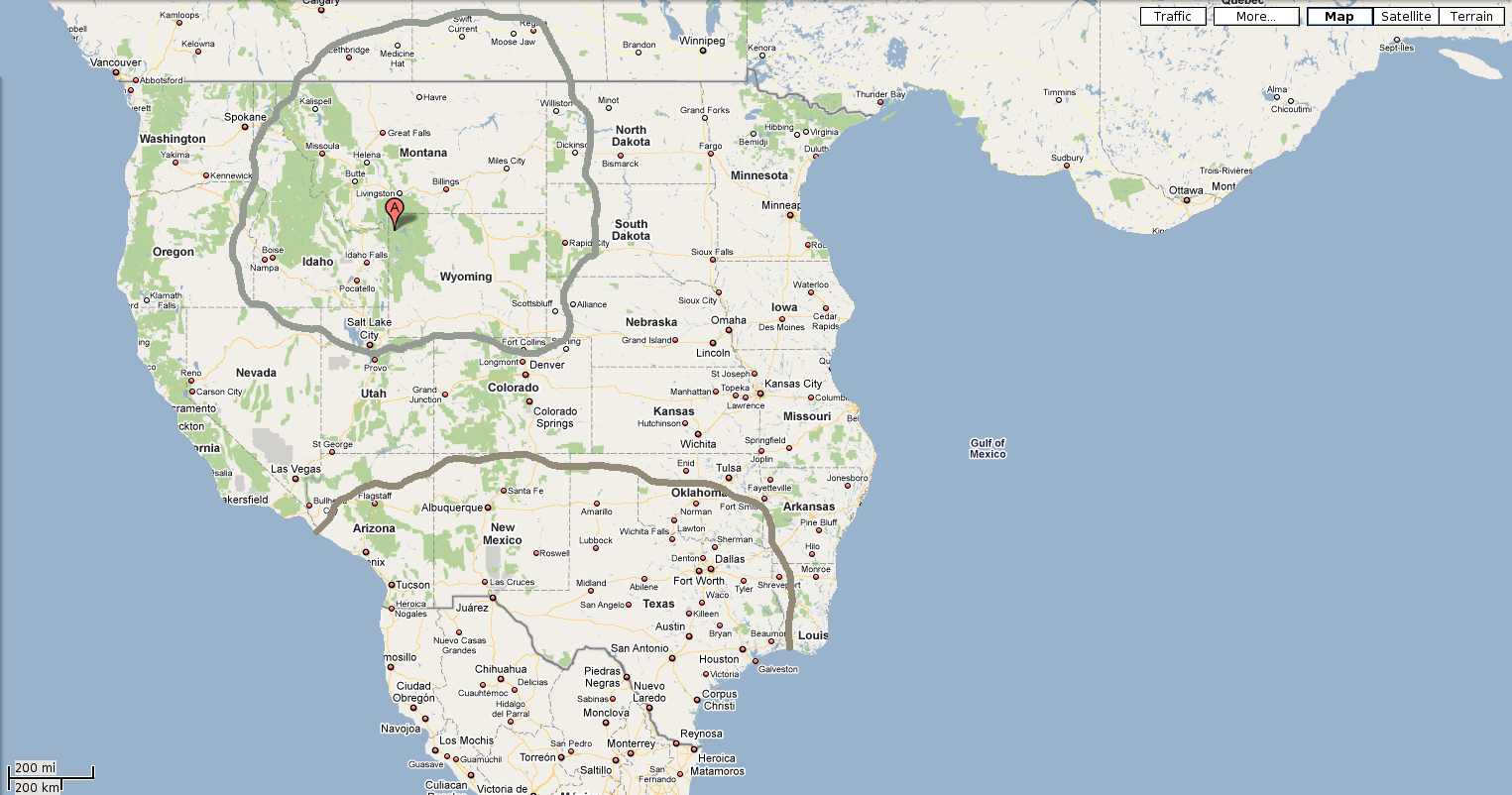
Finally I started brainstorming on the history of the DC world (more below), and came up with a rough map of the USA. Um, in short, it looks awesome. So hooray let me post that! (Thanks to Google Maps for the basic image of the USA)

Possible USA Map

Now, how exactly am I going to make Dinosaur Cowboys relatively believable? Sure I could just say “A volcano erupted long ago, somehow we ended up with dinosaurs!”, ala the Mad Max approach of “Two great ‘tribes’ nuked the hell out of each other…begin movie!”. But I find a semi-realistic scenario, or just a slightly tweaked real world danger, makes for more believable play. It’s like how most fantasy games are still based in reality, so you don’t have to relearn what gravity is, ya know? Ah the joys of designing games.

The most plausible idea involves the active volcano that vents out via Old Faithful geyser in north-eastern Wyoming. When a supervolcano erupts the most likely outcome is a ton of dust being thrown into the air, giving you a “volcanic winter” (similar to the hypothesized “nuclear winter” from a big enough bomb). But! The other option is a stew of gases spills out and creates a “runaway greenhouse effect”. Ding ding ding we have a winner!

Okay, so the supervolcano erupts (called Eruption Day) in the year 2037. But there is only a thin layer of lava that ACTUALLY causes the eruption. Dust is thrown into the air, but not a ton, and mostly gasses are released. The temperature of the Earth heats up as a result, which causes the ice caps to melt and water to spill into the US. As you can see from the map, everything east of the Mississippi River is basically underwater. The west coast gets hit, but not as hard. The rising temperature makes everything a desert, more or less. South of the brown line is basically unlivable, with Mexico and beyond too hot to stand. Right near the line (ie: southern Arizona, etc.) is hot, but not lethally so.

Now, for the dinosaur part. The big caldera (basically dent in the ground…PS Man do I ever link to Wikipedia a lot!) that makes up Yellowstone Park hints at a previous eruption. Calderas are formed when the volcanic chambers empty out, leaving a big open air room, which then collapses from the weight of the crust and turf above it.

But what if it didn’t collapse, and what if some dinosaurs and seeds found their way into the chamber? Then a thin layer of lava flowed over top of the room, cooling and reforming slowly to make the current surface of the Earth. The next time the volcano erupts it only spits out this thin layer of lava, but also cracks and explodes the top of the empty chamber outwards.

The result is stored seeds and plant life are thrown around along with the dirt, which lands in a big radius relatively equivalent to the greenish circle on the map. The dinosaurs emerge from the chamber and by the time mankind goes to explore the wreckage they find the beasts. Naturally everyone was gravitating towards the vegetation and milder, tropical temperatures. So with the resources of dinosaurs and vegetation, the center around the empty volcano becomes the Neotechnoist civilization, while the rough desert outskirts becomes Duster territory.

Neat!

Flaws with this idea? How did the plants survive underground without sunlight is the main one. I can visualize the chamber as sort of a mini-ecosystem that is self contained and fully supportive of dinosaur life. Then humanity is trying to recover for so long that they don’t have a chance to go back to the volcano for a while, and by the time they do dinosaur life has been established. The dinosaurs eventually roam away from the volcano to try to escape the encroachment of humanity, so then the whole US ends up populated by them.

Seems all believable(ish), considering the starting year is sometime around 2285, so there would be time for vegetation to grow and generations of humans to pass.

The game isn’t meant to be post apocalyptic, so the cities around the volcano will still be advanced and as modern as now. Electricity will be common (from an effort of the Neotechnoists to bring the light of modern living to the “savage” outskirts), etc. Life will be tough, as it was in the bread bowl of the US during the “Wild West” years, but not as apocalyptic as people desperately searching stores for canned food while fighting off roving gangs. It’s a fine line to walk, but I think it will be possible based on the quests and enemies I throw the characters against.

There are plenty of options for exploration and variety. The burning hot southern desert, said to contain untouched riches of the Old World. The submerged cities to the east, ripe for the picking by also naturally dangerous. The main story will still be in the area surrounding the volcano / jungle.

Psyched though! I’ll just have to refine, or blur (from the passage of time) the history of DC a bit, but the whole focus on Yellowstone and the ecosystem chamber seem cool enough to work. Yep yep!

Hurray updated sheet

I’ve implemented my playtesting feedback into the character sheet, and added a stylish silhouette six-shooter image to the middle, so yeah, starting to look rather rad.

As before, grab the file as:

When I work on the rules I keep it all in a Subversion repository, but for these uploads I’ll just attach arbitrary version numbers.

Character sheet example

I figured I should post the character sheets I used yesterday, in case you’re SO excited to try the rules that you want to do an early playtest too (send me feedback if you do!).

But yeah, I’ve created it as a fancy pants Open Office (.odt format) spreadsheet. Making character sheets has always been great fun since you can see them evolve as the game grows and you play it more. I find I add more whitespace and bigger rows to make it easier for people to write, and a bunch of temporary fields for values my friends normally track anyways on the bottom or back of the sheet.

I imagine this will change in the future, even if just slightly, but for now it gives you a good idea of how the main character will look on paper.

So, grab the sheet as:

And if you want to just get a glimpse of how it looks, here’s a screenshot of the PDF:

Character Sheet v0.1

First playtest already

Holy kacholey, Dinosaur Cowboys v0.0000001 is fun. Basically I whipped up a character sheet yesterday at work and printed 4 off. Then I got home, set up a bit of terrain and a few mounted figures I had (druid riding a lizard vs. goblin riding a winged lion ftw!) and played 3 small “battles” using only my brainstorm rules. The first two battles were between a Duster and Neotechnoist (Duster won both because of some overpowered weapons), and then both of them against a generic enemy dinosaur (using a plastic toy thing I got from a museum).

But yeah, lots of fun. I honestly feel that the game is a return to my teenage roots of Horizon (a fantasy game I made instead of playing D&D). The combat is fast and simple with minimal rolling before you can apply damage. The character sheets are clean with few stats and plenty of opportunity for (relatively) fast playing larger battles.

I still need to start on the ACTUAL rules, instead of just going off a well defined brainstorm document, but yeah, I bet I could be done a first version of this mofo in a single night. Then I get the exciting job of working up background information and maps and cool stuff like that. Weapon lists and enemy lists will likely be the biggest stumbling block, but since I’m working with new material (dinosaurs!) I think I might be more motivated. Plus the idea of having a giant book of foes is enticing.

Heck I remember my Horizon enemy book, it was about an inch thick and stacked with pages and pages of enemies in a crude, simple format. I don’t even think it was organized alphabetically, and I made all the stats up off the cuff, but somehow everything was still balanced and workable. I got to know that book so well that I could just turn directly to common foes like Black Bears and Goblins and stuff. Man what a blast.

But anyways, here are the notes from my playtest, some of which is painfully obvious but you don’t realize it until you actually sit down and start rolling dice.

+ Notes from December 01 Playtest

- Damage Track is written in pencil, and marked off in pencil, so erasing is an issue
 - Use sliding counters instead?
- Write Current AR and Current Movement formula below field?
- Need a hint for Armor Name location by Armor Rating
- Need a space for Current Melee Attacks under Dinomount
 - Might want to keep all temporary fields in one place, or formatted the same
- Need rules for transferring extra damage from downed Dinomount to rider, before they dismount
 - All extra damage goes to rider? ie: 5 damage, 2 track boxes left, 3 goes to rider?
- Clarify reload rules...
 - Basically you spend your whole firing phase reloading a single gun
  - OR you can fire another gun, but the unreloaded weapon remains unreloaded
 - Recommend just marking an 'R' beside the weapon column on character sheet
- Need a second divider line on all Current boxes, to store the starting value
 - ie: HP: |__|______
- Call firing phase 'Action Phase' and include item use (such as healing kits)
- Switch Current HP back to left side so it's easier to write around damage track counter
- Consider having Henchmen / Followers on the same "mini sheet" as generic enemies
 - Makes sheet shuffling less of a hassle
 - Could even fit 3 Followers (the maximum?) on a landscape spreadsheet full of mini sheets, maybe
- Added bolded letters for the 'M' in Movement, for example, to help understand Damage Track markings